Transitioning from Classical Software Engineering to Quantum Information Science. Currently focusing on the mathematical foundations and hybrid-classical architectures.

This are my quantum computing notes and resources. (03/Februar/2026)
I had read in book that quantum mechanics are way more easies than classical mechanics (mathematically), but classical are conceptually easier than quantum mechanics
(09/februar/2026)
-
The state of a quantum object is completelly specified by a single wave function Ψ(x) which is a Complex number
- P(x) = |Ψ(x)|^2 determinates the probability-density that the object in state Ψ(x) will be found at x
-
Given two possible configurations of a quantum system corresponding to two wave functions 1) Ψ(x) and 2) Ψ(x), the system can also be in a SUPERPOSITION of these: Ψ(x) = α Ψ_1(x) + β Ψ_2(x) where: α,β are Complex
Quantum states live in a complex vector space (Hilbert space).
SUPERPOSITION means: The particle is in a state that is literally neither 1 nor 2.
Any wave funciton Ψ(x) can be expressed as a SUPERPOSITION in the form:
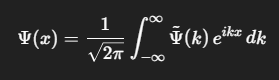
of states w/ defINITE momentum p=ℏk
-
(next one is in stand by)
(12/februar/2026)
Experiments in quantum mechanics are never gentle. Here "not gentle" means:
- Looking at a planet
- Reading a thermometer
- Weighting something
Why? because it's impossible in principle. Measurements are interactions strong enough to:
- Project wavefunctions Ψ(x)
- Destroy phase relations
- Select one outcome from a SUPERPOSITION
Those interactions must transfer: Energy, Momentum and Phase Information
Here's my github repot with quantum stuff: quantum stuff
(21/februar/2026)
this is more mathematical: vector spaces to define quantum mechanical states are called Hilbert Spaces
Motivating example: Euclidean vector space
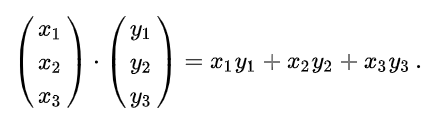
another wonderful idea of Hilbert spaces is that they are abstract mathematical areas to track probabilities of a quantum state
Inner Product
Dot product on steroids.
While standard dot"+product tells the angle between two lines. in a Hilbert space the inner product tells the overlap (or similarity) between two quantum states
(22/februar/2026)
State of Spin in quantum mechanics describes the intrinsic angular momentum of a particle and the probabilities of measuring specific spin values along a chosen axis
(15/März/2026)
- state = vector a single qubit e.g.: psi = [a, b]
- observable = Hermitian operator value = psi† A psi
- gate = unitary operator psi' = U psi
- evolution = linear differential equation i dpsi/dt = H psi
- measurement = spectral decomposition p_i = <psi|P_i|psi>
- conservation of probability = continuity + divergence What comes out of one point goes into another → constant total probability.
- simulation = exponential of operators exp(-iHt) = I - iHt + (-iHt)^2/2! + (-iHt)^3/3! + ...
(13/07/2026)
I realized I need to know classical mechanics in order to study QM